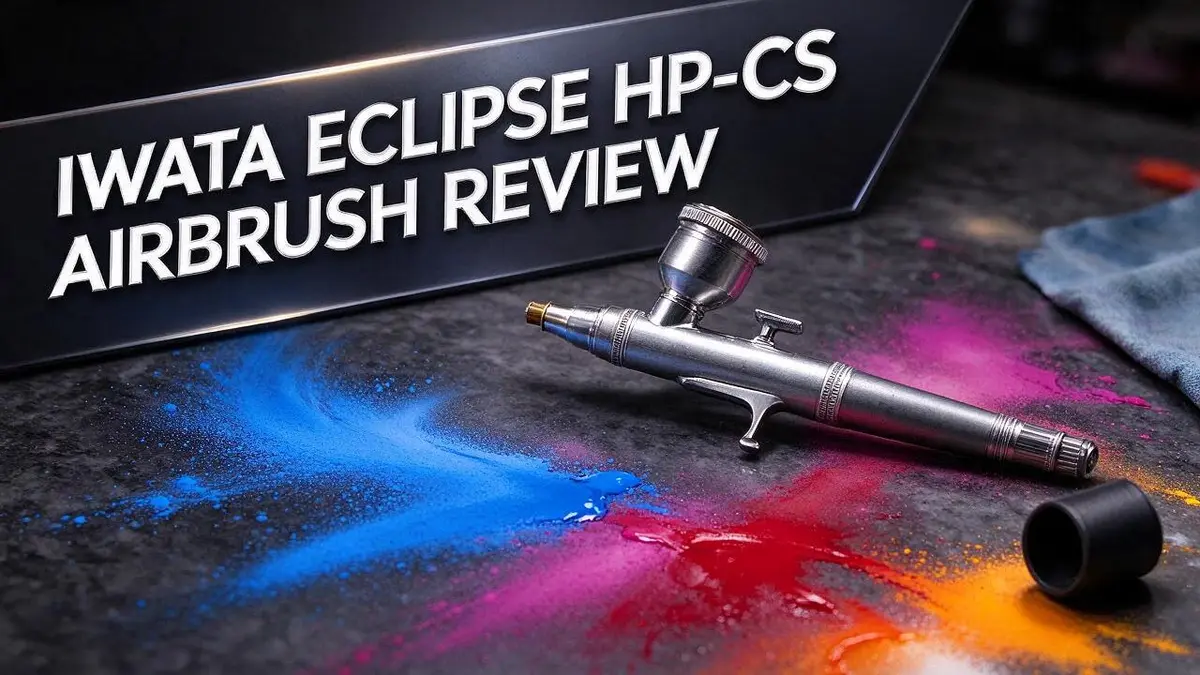
Iwata Eclipse HP-CS Airbrush Review 2026: Worth Buying?
If you paint models, art, or custom projects, you need an airbrush that performs well every time. The Iwata Eclipse HP-CS is a favorite among hobbyists and pros. It earns its reputation as a true workhorse.
This dual action airbrush uses a gravity feed design. Its 0.24 oz cup holds enough paint to keep you working. The removable cutaway handle makes clearing clogs quick and simple.
Users often praise its smooth atomization and efficient paint flow. It handles general coverage and fine detail well. It also works nicely with pearlized paints.
In a Nutshell
- Built for many projects: The Eclipse HP-CS handles general coverage and fine detail with equal ease. One tool covers many jobs.
- Larger paint capacity: It holds a bigger 0.24 oz gravity cup than its sibling, the HP-BS. Fewer refills mean more time spent painting.
- Quick fix for clogs: The removable cutaway handle gives you direct access inside the airbrush. You can clear a blockage fast and get back to work without a long break.
- Resists harsh cleaners: The body holds up against solvents. Strong chemicals will not wear it down quickly, so routine cleaning stays worry free.
- Good with pearlized paints: Shimmery finishes flow through it well. Custom work with pearl effects looks rich and even from start to finish.
- A proven workhorse: Many artists describe it as an industry standard. Its reputation rests on steady, reliable results over long painting sessions.
- Worth a closer look: The research found no clear downsides. Still, test it with your favorite paints before you settle on it.
Design and Build Quality

- Ultimate Versatility – Achieve ultra-fine lines to broad sprays with the Iwata Eclipse HP-CS, perfect for auto graphics, model painting, cosplay, textiles, crafts, and more.
- Easy Maintenance Design – Features an exclusive compression-fit E3 nozzle (no threads!) and quick-flush cutaway handle for fast needle access and simple cleaning.
Last update on 2026-11-20 / Affiliate links / Images from Amazon Product Advertising API Some of the links on this website are affiliate links, which means that at no additional cost to you, I earn a commission if you click through and make a purchase. I only recommend products and services that I believe will add value to my readers. Thank you for your support!
Build quality shapes how an airbrush feels over time. A sturdy body keeps your focus on the art instead of on repairs.
The Iwata Eclipse HP-CS shares its design with its sibling, the HP-BS. The main difference is the paint cup, so the rest of the build matches closely.
If you already know the HP BS, the HP CS will feel familiar in your hand. That makes comparing the two models simple.
Check the body for clean seams and snug fittings when the airbrush arrives. Loose parts can affect spray control.
Pay close attention to the nozzle and needle. These parts shape your fine lines and your spray pattern.
Test how the airbrush sits in your palm. Comfort matters more during long painting sessions than most people expect.
Small details often reveal the quality of a build. Press the trigger gently and notice how it responds. A smooth, steady response usually points to careful construction.
Notice whether the parts feel firm or wobbly. Firm parts usually mean a longer working life.
The Eclipse line focuses on practical design rather than flashy extras. Many users value that simple approach.
Good design lasts longer than passing trends. That idea fits well with this airbrush.
Keep the nozzle clean and dry after each session. A little routine care protects the finish and the internal parts.
A simple, sturdy design also makes repairs easier. You can spot problems faster and fix them sooner.
For beginners, a durable tool reduces the risk of damage while learning. Mistakes happen, so reliable gear helps.
Professionals also gain from dependable build quality. They need tools that perform well on tight deadlines.
Buyers should weigh build quality alongside their painting style. A detailed model painter and a mural artist may use the tool in very different ways.
Ultimately, build quality supports your creativity. The right tool lets you focus on color, texture, and detail.
Spray Performance and Atomization
Spray performance decides how your finished work looks. Atomization is the process that breaks paint into a fine mist. A fine mist gives you soft edges and smooth blends on every surface.
The Eclipse HP CS turns air and paint into a steady spray. Its dual action design lets you control both air and paint at the same time. This gives you direct command over each stroke.
Trigger control is the main skill to learn. Press down to release air. Pull back to add paint. Small movements create big changes in line width, so take your time.
Your compressor matters too. A steady air supply keeps the spray pattern even from start to finish. Pulsing air can cause spitting or uneven coats that are hard to fix later.
Thinning paint is another key step. Many artists thin their paint to a milky consistency before spraying. Test your mix on scrap cardboard before you touch your project. This simple habit saves time and frustration.
Distance changes the spray pattern as well. Hold the tip close for sharp lines and crisp detail. Move it farther back for wider, softer coverage across larger areas.
Practice with simple strokes first. Try fades, dots, and straight lines. These drills build muscle memory fast, and they show you how the airbrush responds to your hand.
Watch for spitting during your session. Spitting often signals clogged paint or loose fittings. Check the nozzle and needle before you blame the airbrush itself.
Lighting also shapes how you judge the spray. Work in bright, neutral light so colors look true. Dim or warm light can hide thin spots and uneven layers.
Finally, take breaks during long sessions. Fresh eyes spot uneven coats much faster. Steady hands also stay steady for longer when you rest between passes.
Paint Compatibility and Finish Range
Paint compatibility matters more than many beginners expect. The Eclipse HP-CS gives you room to work with different paint types. Its body resists harsh cleaners, so you can switch cleaning solutions with confidence.
Solvent resistance also helps when you change paint brands or formulas. You can move from one paint to another with less worry about damage. Still, always check the label on your paint first.
Thinning is a key step before you spray. Most airbrush paints need thinning to reach a smooth consistency. Thin paint sprays evenly and dries with a clean surface. Thick paint can block the tip and leave rough texture behind.
The finish range shows what this airbrush can do. Smooth atomization lets you build soft gradients and crisp edges. Light passes give you subtle shading. Heavier passes add bold, solid color.
The same airbrush covers large areas and tight details. That range suits projects like models, illustrations, and custom craft pieces. You do not need a second tool for each finish. Artists can layer thin coats for depth or spray one heavier coat for a solid look.
Test on scrap material first. Spray a small sample on the same surface you plan to use. Compare the finish once it dries. Notice whether the color looks flat, glossy, or grainy.
Keep notes on each test. Write down the paint, the thinning ratio, and the air pressure. Over time, you build a personal reference. That reference saves time on future projects.
In the end, no single finish suits every project. Mix techniques to reach the look you want. The Eclipse HP-CS gives you a flexible starting point for almost any finish.
Top 3 Alternatives
Paasche VL Airbrush

- PAASCHE'S MOST POPULAR AIRBRUSH: The VL is a double action, internal mix, siphon feed airbrush known for its durability and its ability to spray most materials, thick or thin. The double-action trigger controls air and paint separately for smooth, precise control. Replaces the VL-SET.
- THREE HEAD SIZES FOR LIGHT TO HEAVY PAINTS: Comes with .55mm (Size 1), .75mm (Size 3, installed) and 1.05mm (Size 5) heads, from fine detail to broader coverage with light, medium and heavy fluids. The rounded head lets you pinch off dried paint with your fingers.

Last update on 2026-11-20 / Affiliate links / Images from Amazon Product Advertising API Some of the links on this website are affiliate links, which means that at no additional cost to you, I earn a commission if you click through and make a purchase. I only recommend products and services that I believe will add value to my readers. Thank you for your support!
The Paasche VL is a classic single-action airbrush that many artists trust. It has a simple design and a small footprint. Beginners find it easy to clean and easy to control. Its metal body feels solid in the hand. Replacement parts are easy to find, so repairs stay simple.
It works well for fine detail, model painting, and light shading. Its needle and nozzle sets are simple to swap. Hobbyists often keep one on the bench for quick touch-ups.
Badger Patriot 105

- High Roller Trigger
- Elongated linear air flow Nozzle
Last update on 2026-11-20 / Affiliate links / Images from Amazon Product Advertising API Some of the links on this website are affiliate links, which means that at no additional cost to you, I earn a commission if you click through and make a purchase. I only recommend products and services that I believe will add value to my readers. Thank you for your support!
The Badger Patriot 105 is a dual-action airbrush with a smooth trigger. You control paint flow and air separately. This gives you more freedom with each stroke.
Many people use it for cake decorating, nail art, and tattoo touch-ups. It feels comfortable in the hand. The set includes a gravity feed cup that holds paint well. Cleanup feels quick and simple.
Grex Genesis Airbrush

- Everything Ready in a Box To Go | The Grex GCK05 features the new Grex Genesis.XGi - and combines everything needed to easily setup a full airbrush system.
- The Genesis.XGi is top fed and is the most ergonomic traditional dual action airbrush available - one of the most comfortable and versatile airbrushes.
Last update on 2026-11-20 / Affiliate links / Images from Amazon Product Advertising API Some of the links on this website are affiliate links, which means that at no additional cost to you, I earn a commission if you click through and make a purchase. I only recommend products and services that I believe will add value to my readers. Thank you for your support!
The Grex Genesis is a gravity-feed airbrush built for precision. It has a sturdy body and a fine tip. Artists love how it handles thin paints and inks.
It suits illustration, miniatures, and detailed hobby projects. Cleaning takes only a few minutes. Many users say it feels light and balanced during long sessions. Its gravity feed design lets you add paint without extra tubes. Many hobbyists choose it for crisp lines on small surfaces.
Cleaning and Maintenance
Clean your airbrush right after every session. Paint dries fast inside the cup and tip, and dried paint causes clogs. Waiting until the next day makes the job much harder.
Start by emptying the cup. Pour leftover paint into a jar for later use. Rinse the cup with a small amount of airbrush cleaner. Swirl it gently and pour it out. Repeat until the rinse runs clear.
Next, spray clean cleaner through the airbrush. This pushes out paint trapped in the air passage. Aim the tip into a waste cup or a folded paper towel. Use short bursts until only clear liquid comes out.
The HP CS resists solvents well. You can use common airbrush cleaners without worrying about damage to the body. Still, read the label on your cleaner and follow its safety notes.
Use the removable handle when a clog appears. The cutaway design gives you direct access to the inside. Unscrew the handle carefully and clear the passage with a soft brush. Never force a wire or pin into the opening.
Wipe the outside every time. Paint film often builds up on the body and trigger. Use a lint free cloth dampened with cleaner. Gently wipe the trigger area so it moves freely.
Once a week, take the airbrush apart for a deeper clean. Soak small parts in cleaner for a short time. Dry each piece fully before you reassemble it.
Store your airbrush in a dry place. Dust and moisture can build up around the tip and cause problems. A small case or a stand works well. Cover the tip when the airbrush sits on your desk.
Avoid soaking the entire airbrush for long periods. Soak only the front parts that touch paint. Water left inside the body can seep into areas that should stay dry.
A quick clean after each session saves time later. Make it a simple habit. Your strokes stay smooth, and your artwork looks sharp every time you pick up the brush.
Pros and Cons
Pros
- Trusted as an industry-standard workhorse in many studios
- Handles pearlized paints with ease
- Built tough enough for regular, daily use
- Works well for both broad coverage and close detail
- Gives you a reliable tool that many artists keep for years
Cons
- The small 0.24 oz cup means more refills on large projects
- Pearl paints can settle in the cup, so stir often
- Fine detail work still takes a steady hand and practice
- Our research lists no cons, so test it on scrap material before you commit to big jobs
Who Should Buy It
This airbrush suits hobbyists who want one tool for many projects. Model builders, miniature painters, and sneaker customizers often switch between small details and larger surfaces. This airbrush handles both jobs without needing a second setup.
Beginners who want to learn at a steady pace can start here. Many new users feel overwhelmed by complicated gear. A straightforward airbrush keeps the focus on practice and control. Good habits form early when your tool feels consistent.
Experienced painters often look for a reliable backup during busy deadlines. When a project runs late, you need a tool that starts quickly and cleans up with ease. This model fits that role well.
Art students and workshop members also benefit from this design. Classrooms and shared studios see many hands on the same equipment. Shared equipment also needs a model that is easy to maintain. A forgiving tool helps students build skills without frustration, and it gives instructors one model to teach with.
Anyone starting a first airbrush collection should consider it carefully. A dependable first choice gives you a clear baseline. This approach helps you understand what you truly need before adding more gear.
Some buyers may want a different path. Artists who spray only large murals or heavy base coats may prefer a tool built for bigger volumes. Likewise, people who never plan to detail small areas may not use the full range this model offers.
Limited bench space makes a focused setup easier to manage. A single, reliable tool is simpler to store than a shelf of specialty airbrushes.
Your daily projects should guide the final decision. If you value versatility and want one reliable tool for varied work, this airbrush deserves a close look. Think about the surfaces you paint most often, and the choice becomes clearer.
Ultimately, the right buyer wants steady results across many projects. This airbrush is not made for only one specialty task. It fits people who paint a little of everything.
Final Verdict
Our final verdict is very positive for most painters. The Iwata Eclipse HP CS gives you smooth results on many kinds of projects.
Think of it as a versatile tool that handles everyday work with ease.
Its strengths are clear. Atomization stays smooth, and paint flows at a steady rate.
The bigger question is whether it fits your own goals. Your skill level and project list matter most.
If you paint a mix of small and large pieces, this model adapts well.
A gravity feed design also keeps paint visible in the cup. You can judge the color at a glance.
Our sources did not list any cons, but that does not mean the tool suits everyone.
Your own hands on test will teach you the most. Give it a fair trial over several weeks.
Artists who need very heavy flow for large coats may want to compare other models first.
Here is a simple way to decide. Ask yourself three questions before you buy.
Do you need one gravity feed tool for many kinds of work?
Do you paint pearl or metallic finishes often?
Do you want one airbrush that grows with your skill?
If you answered yes to most of these, this airbrush fits your bench well.
Bottom line: the Iwata Eclipse HP CS is a reliable choice for most airbrush users.
It earns its reputation through steady performance and simple upkeep. Start with a clear plan, then let the tool show what it can do.
Confidence grows when you know a tool well. Spend time with it on regular projects, and you will see its strengths quickly.
Keep a short log of what works. Note paint thickness, air pressure, and distance so you can repeat good results.
Over time, that log becomes your own guide. It helps you grow faster than any review can.
Frequently Asked Questions
Is this airbrush a good choice for beginners?
Yes, beginners can learn here at a steady pace. Start with simple shapes on scrap material. Focus on air pressure and paint thickness before you move to detailed work.
How do I keep paint from clogging the airbrush?
Clean the tool right after each session. The removable cutaway handle gives you easy access to the inner parts. Check the tip often, especially when you spray thick or pearl finishes.
What should I practice on before a real project?
Use cardboard, old test panels, or spare plastic. Adjust the spray until the line looks even and smooth. Write down your settings so you can repeat good results later.
Can I use this airbrush with strong cleaners?
Yes, the tool is solvent resistant, so it handles most common cleaners well. Still, check your paint maker’s guide before you mix new products. Rinse the cup and needle thoroughly to protect the finish.
How should I store it between projects?
Keep it in a dry case away from dust and overspray. Empty the cup and rinse it before you put the tool away. Clean parts last longer and perform better on your next job.

As a fashion trend expert with a passion for self-expression and body art, I’ve built a reputation as a trusted source for inspiration and advice on fashion trends and tattoo designs. With a background in fashion, I’ve worked with various fashion brands and designers, and have written for several fashion publications. I’m excited to share my knowledge and expertise with you through my blog, Inner Beauty Blog, where I showcase a wide range of tattoo designs and share my thoughts on the latest fashion trends.